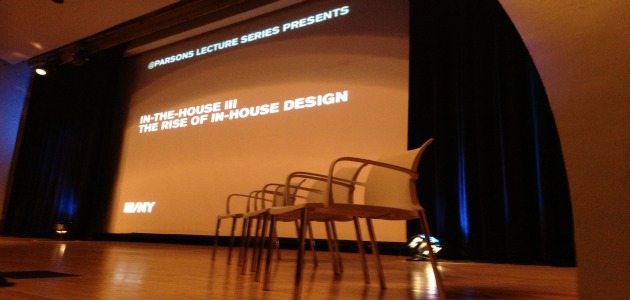
 Being an in-house designer isn’t as sexy as working at a big-shot design agency or having your own business. It’s certainly no Mad Men. As Museum of Modern Art Creative Director Julia Hoffmann pointed out in a recent AIGA/NY lecture, “In the House III: The Rise of In-House Design,” design agencies and freelancers are perceived as having the ability to swoop in for big, creative projects, while in-house designers are often stuck with the same old logo and typeface (fortunately she likes MOMA’s logo and typeface). Hoffmann and her fellow panelists, Facebook’s Ji Lee and J. Crew’s Johanna Langford, believe that being an in-house designer has silver linings, even if it’s not quite meant for the silver screen. Below, we’ve listed five perks of being an in-house designer from the lecture at Parsons The New School for Design.
1. Knowing your company
When you work with a company day in and day out, you not only learn its mission, but you also become familiar with all of its products—not just the one you’re designing for at that moment. That leads to a much more holistic and unified approach to the company’s design. At the MOMA, where the design work is to “visually communicate the museum,” the team of designers must “make sure people come to the museum and then find their way around the museum.” That means the six in-house designers are familiar with the museum’s art, its patrons, its signage, mailing and more. They know the museum inside and out, and are thus better able to design for it.
2. Caring about your company
 In addition to knowing their brand, designers who are happy with their jobs can also come to deeply care about it and take pride it. Langford, who is VP of Brand Creative at J. Crew, said that she developed an “emotional connection to the brand” as an employee and a customer. She tries to convey that brand nostalgia in the company’s advertising. Accordingly, she said, it’s important to find a company that fits your personality. Lee, a Facebook designer, agrees: “I’m only going to work for a company I believe in.” That concept caused him to make the jump from Google to the social network, after he found that he largely identified with Facebook’s hacking culture and entrepreneurial ethos. “It’s rewarding because I believe in this company’s mission,” Lee said.
3. You can experiment/screw up
While design firms are usually trying to impress a one-time client on a single project — which often means giving clients what they expect — in-house design teams have more latitude to experiment and, by extension, make mistakes. That’s because they’ll likely still have their job the next day, while freelancers and agencies run the risk of not being hired again. One of the MOMA’s designers who presented along with Hoffmann, Greg Hathaway, described an over-the-top series of advertisements and title walls for an exhibition by installation artist Claes Oldenburg. Hathaway had wanted to design the exhibition in the same vein as Oldenburg’s delightful large-scale works (think of his upside-down ice-cream cone). For the MOMA design team that meant 3-D fonts and a guerilla marketing campaign at fastfood chain Shake Shack. Unfortunately for the team, Oldenburg took his work a lot more seriously and they had to redesign everything. “Our dreams of a fastfood empire didn’t take off,” Hathaway said. “That’s OK because there’s always the next show.”
4. You’re in it together
Lee started out at Facebook as a creative director but found that the egalitarean work ethos there made him a better fit as a general contributor. According to Lee, that was fine with him because being equals means understanding one another’s contributions better, a relationship that improves the workplace environment overall. “Where there’s usually mistrust between accounting and creative, for in-house we’re all working toward the same goal so there’s more respect,” he said. “Everybody has the same mission.”
5. More time
In-house designers not only have more time with a company than freelance designers, they also seem to have more time in general, according to the MOMA’s Hoffmann. “Ad agencies are super fast,” she said, while “museum in-house is super slow.” There are a number of reasons for this, many of which touch on the understanding built out of the above four perks. And the benefits are obvious. While deadlines might help push out a product quickly, time will help create a better one. The fulltime structure also allows for longterm thinking about the company and longterm projects, which might be too amorphous for visiting design teams to take on or even understand. For Lee, that infinite time—although he says each individual project is rushed—has let him step far outside his comfort zone, not to mention the boundaries of commissioned design. He even helped decorate Facebook’s newer New York offices—a commission that probably wouldn’t be on a graphic-designer’s job description. Rani Molla has a digital media master’s degree from Columbia Journalism School. She’s a journalism reader, writer, photographer, videographer, data visualizer and general doer. Follow her on Twitter.